On Monday, August 31, the Knox County Commission did something that almost never happens in local government: it voted unanimously to get rid of a technology. Emergency ordinance O-26-8-102 ordered all automatic license plate readers (ALPRs) in the county shut off and removed within 30 days, roughly 143 Flock Safety cameras mounted on poles across Knoxville and the surrounding area. Because it was an emergency ordinance, a single reading was enough to make it law. Commissioners rarely agree on anything. On this, they didn't need a second try.
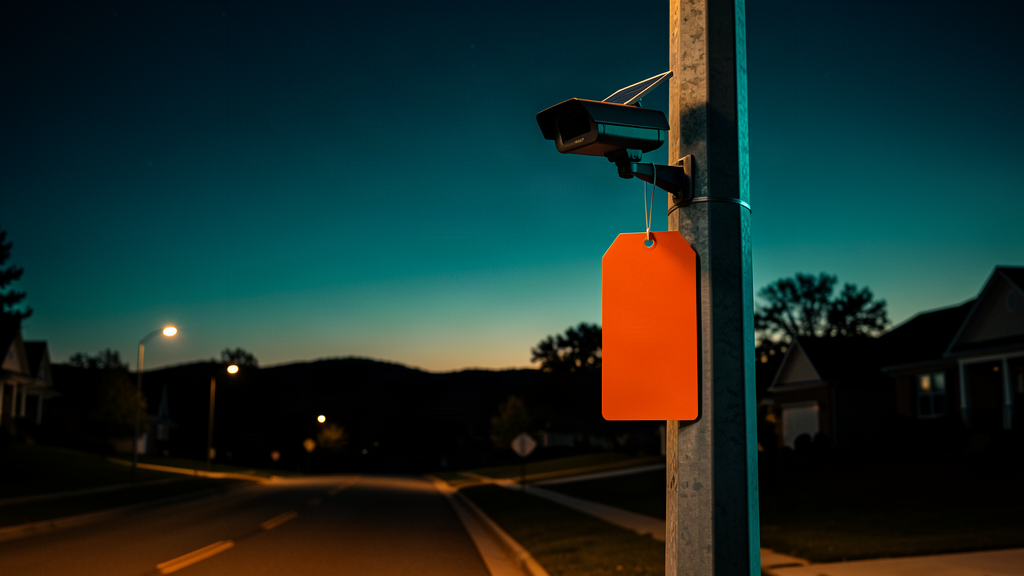
About 100 residents packed the room for the vote, many carrying signs. One read a simple message: "DeFlock Knox." By September 17, Flock crews had pulled down 133 of the cameras. The last stubborn few were capped with orange covers before coming down in early October. Your commute in Knox County is, for now, no longer being quietly cataloged plate by plate.
How We Got Here
The procurement is the story. When the Knox County Sheriff's Office tried to use grant money to nearly triple the network, adding around 270 more cameras on top of the ~140 already in place, residents and commissioners started digging. What they found turned a privacy debate into a procurement scandal:
- KCSO had spent years buying cameras in batches priced just $10 under the $25,000 threshold that would have required review from the mayor's office
- An $800,000 lease purchase through a cooperative purchasing agreement only surfaced during an Aug. 25 commission meeting. That mechanism is normally reserved for commodities, not multi-year service contracts
- A $2.6 million maintenance request was waiting in the wings, and the county said it was never clearly told about the full cost of the leasing agreement
- Mayor Glenn Jacobs' office raised the possibility that the entire agreement may have been invalid, contracted without the review that was required of it
- Some cameras weren't even permitted to sit where they sat: mounted on utility poles in the county right-of-way without a permit, and some not meeting federal pole-safety standards
The vote made Knox County part of a genuinely bipartisan national wave. Cities across the country, red-state and blue-state, have canceled Flock contracts or deactivated their plate readers in 2026. On the federal side, Rep. Tim Burchett (R-TN) introduced the Protection Against Mass Surveillance Act (H.R. 9800) in July to bar federal agencies from buying or using automated surveillance systems and to cut off federal funding for them at the local level. State Rep. Jason Zachary (R-Knoxville) is drafting legislation that would restrict plate-reader data access to certified law enforcement personnel only, with real penalties for abuse. The Institute for Justice has documented more than 100 incidents of ALPR abuse nationwide, including officers running plates on people they knew, and wrongful stops.
What the Headlines Will Miss
The cameras were never the breach of trust. A camera on a pole is just a camera. The danger sat in everything around it:
- A vendor contract signed without the review the county required
- Purchases structured to avoid oversight thresholds, some by exactly $10
- Plate data flowing into a nationwide network shared across hundreds of agencies
- No clear local policy on who could search it, for what, or with whose authorization
- No requirement that residents ever get to vote on the whole arrangement
When someone shows up next year selling a cleaner, more accurate, more "privacy-respecting" plate reader (same poles, new logo) and offers Knox County a discount to try it, none of those structural problems get fixed. The hardware is interchangeable. The policy vacuum isn't. The ordinance matters more for its language than its list of cameras: beyond ordering removal of the equipment, it prohibited new agreements with companies that provide the equipment and required the plate data to be destroyed along with the hardware, unless tied to an active criminal investigation. A policy decision like that outlasts any vendor.
The Same Lesson, Sitting in Your Living Room
The same trap exists in your house, at a friendlier price point.
Most smart home devices are sold on features and a monthly fee: doorbell cameras, indoor monitors, smart locks, voice assistants, connected TVs. Like Flock's cameras, the hardware in the box is the least interesting part of the deal. The interesting part is the service agreement nobody reads:
- Where does the video go? In most cases, a cloud server you'll never see
- Who else can access it? Some doorbell companies hand footage to police without a warrant
- How long is it kept, and is it sold to data brokers or advertisers?
- What happens when the subscription lapses, or the vendor gets acquired?
Switching from one camera brand to another solves nothing. The footage still lives on someone else's servers, governed by terms that can change with a terms-of-service update. Knox County learned its lesson the expensive way: swapping the vendor is not a privacy plan. Policy is the privacy plan. For a county, that meant an ordinance, enforced data destruction, and a formal ban on no-audit surveillance agreements. For a homeowner, it's simpler:
- Ask what device needs the internet at all. Many work fine on a local network
- Put IoT gear on a separate network segment so a compromised camera can't see your computer
- Check what footage goes to the cloud, turn on local storage where possible, and turn on auto-delete
- Replace always-listening devices with local-only options where they exist
That's essentially a version of what Knox County just did at the county level: inventory, restrict, localize, and put rules around the data before trusting any vendor with access.
Knoxville Led On This
National outlets will mostly skip this story, because "a county commission in Tennessee voted on cameras" doesn't have national reach. The vote was unanimous though, in a county that splits red and blue, and it happened for one reason: people showed up to a Monday evening meeting and said what they wanted.
The cameras came down because residents kept showing up, and because the paper trail (batch-buys under thresholds, an $800K lease nobody flagged, a $2.6M bill coming due) collapsed under its own weight. The equipment is gone. What Knox County actually settled is that surveillance is a policy problem, not a product problem, and your home network deserves the same standard the county just applied to its rights-of-way.
Want the same standard applied to your network? The Fiber Dad does home network privacy audits: inventory what's listening in your house, segment the devices that don't need the internet, and lock down what does. If you ever need anything, just reach out.
Sources: WUOT (Sept. 2) · WVLT (Sept. 1) · Knox News (Sept. 17) · NPR (Sept. 5) · Police1 on H.R. 9800 · ABC News / Institute for Justice